
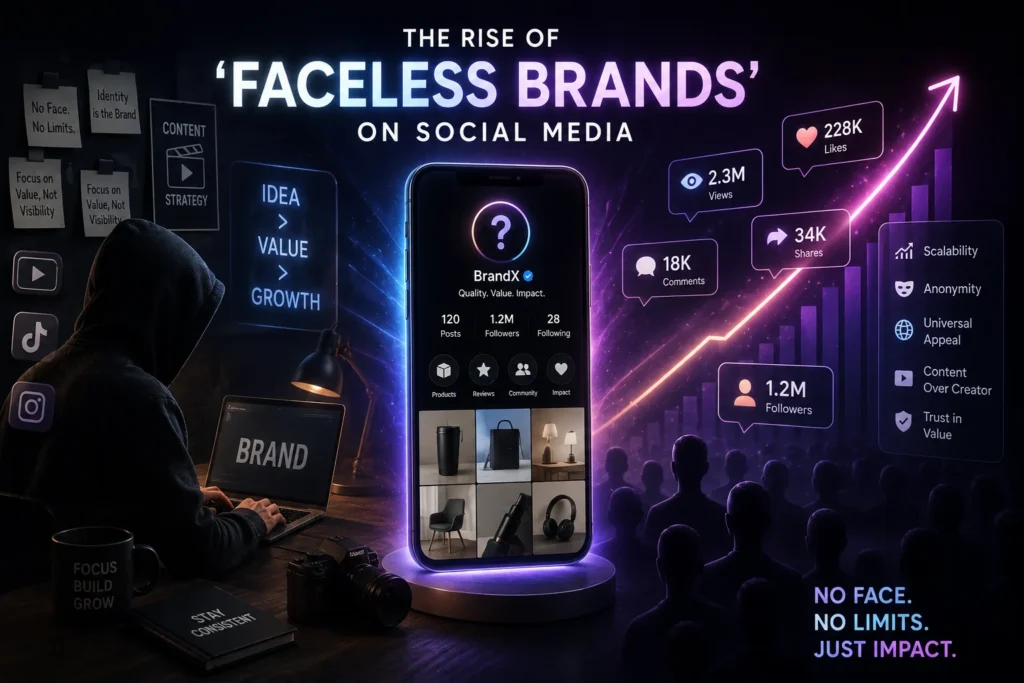
“Some of the fastest-growing brands are built by people nobody has seen.”
A few years ago, social media was obsessed with faces.The creator economy revolved around influencers showing their lifestyle, their routines, their personality, their morning coffee, and sometimes even what they ate for dinner. Brands wanted founders to become celebrities. Every platform pushed visibility, personality, and constant exposure.But something strange started happening.Anonymous meme pages began getting more engagement than polished influencers. Faceless YouTube channels started generating millions of views. AI voices began narrating viral content. Minimal Instagram pages with no human presence started building loyal communities. Suddenly, people realized something important:You do not always need a face to build trust online.In fact, sometimes removing the face makes the brand even stronger.The internet is entering the era of faceless branding — where identity matters more than personality, and ideas matter more than appearance.
The Internet Is Tired of Performative Personal Branding
For years, creators were told the same thing: “People buy people.” And while that is still true to some extent, audiences today are also exhausted by constant self-promotion. Everywhere online, people are trying to become the “main character.” Every reel feels overly rehearsed. Every podcast clip feels strategically emotional. Every LinkedIn post sounds like a motivational speech disguised as vulnerability. Audiences have become smarter. They can instantly sense when authenticity is being manufactured. That is one reason faceless brands are growing so quickly. They remove the pressure of performance and shift attention back to the content itself.
- A meme page does not ask you to admire the creator’s lifestyle.
- A faceless educational channel does not need luxury aesthetics.
An anonymous storytelling account simply delivers value, humor, or emotion without demanding attention for the person behind it. Ironically, removing the creator sometimes makes the content feel more human.
The Rise of Anonymous Creators
One of the biggest shifts in modern social media is the rise of anonymous digital identities. Today, some creators intentionally hide their faces, names, and personal lives while still building massive audiences. Platforms like Instagram, TikTok, YouTube, Reddit, and X are filled with creators operating behind logos, animations, illustrations, AI voices, fictional characters, or text-based content.Think about meme pages. Most people do not know who runs the pages they interact with daily. Yet they still trust them for humor, trends, commentary, and even cultural understanding. The audience connects with the voice of the page rather than the face behind it. That changes everything. It proves that online identity is no longer dependent on physical presence. Instead, identity is being built through:
- Tone
- Humor
- Beliefs
- Consistency
- Aesthetic
- Cultural understanding
- Emotional relatability
In many ways, faceless brands feel more universal because audiences project themselves into them.
Faceless YouTube Channels Are Quietly Dominating Attention
One of the clearest examples of this trend is YouTube. Thousands of faceless channels are now generating millions of monthly views using:
- AI narration
- Stock footage
- Animations
- Screen recordings
- Text storytelling
- Documentary editing
- Commentary formats
Many viewers never question who owns the channel. They only care whether the content is interesting. This is especially visible in niches like:
- Finance
- Productivity
- Tech explainers
- Motivation
- Crime documentaries
- History storytelling
- Reddit reactions
- AI education
The creator becomes secondary to the experience. And because the audience focuses entirely on the content, faceless channels often scale faster and more efficiently than personality-driven brands.
AI Voices Changed the Game
Artificial intelligence accelerated this movement dramatically. Today, creators can build entire brands using AI-generated narration, automated editing, synthetic visuals, and virtual characters. A single person with a laptop can now run multiple content brands simultaneously. That would have sounded impossible five years ago. AI voices, especially, normalized faceless content. At first, audiences found them robotic. But over time, something changed. People adapted. Now, millions consume content narrated by AI every day without even noticing. The audience cares less about whether the voice is human and more about whether the content delivers value quickly. This is reshaping branding itself. Earlier, branding depended heavily on charisma. Now, branding increasingly depends on systems. The brands winning online today are not always the loudest personalities. Sometimes they are simply the most consistent content machines.
Meme Pages Became Cultural Powerhouses
Meme pages are another major reason faceless branding exploded. What started as internet jokes evolved into one of the most influential forms of modern digital communication. Brands once spent millions creating polished campaigns. Now, one funny meme can generate more engagement than an entire production shoot. But meme culture works differently from traditional branding. People do not follow meme pages because they admire the creator. They follow because the page understands them. That emotional recognition creates loyalty. In fact, many fashion and lifestyle brands now collaborate directly with anonymous meme accounts because audiences trust them more than traditional advertising. Humor became the new authority. Relatability became the new luxury. And anonymity became an advantage instead of a weakness.
Minimalism Is Becoming a Brand Strategy
Faceless branding also connects deeply with minimalist aesthetics. Modern audiences are overwhelmed with information. Too many ads. Too many creators. Too many opinions. Too much noise. Minimalist faceless brands feel calmer. Clean typography. Neutral visuals. Quiet storytelling. Soft narration. Slow-paced editing. These brands do not scream for attention. And because of that, they often stand out more. This is especially popular among Gen Z audiences who are increasingly rejecting hyper-polished influencer culture in favor of content that feels emotionally lighter and less performative. Sometimes a simple black logo and a strong idea create more impact than a perfectly curated lifestyle feed.
Why Audiences Connect More With Identity Than Personality
This may be the biggest reason faceless brands are thriving. People do not always want celebrity creators anymore. They want emotional alignment. They want creators, pages, and brands that reflect:
- Their humor
- Their frustrations
- Their ambitions
- Their niche interests
- Their internet culture
A faceless brand allows audiences to focus on shared identity rather than individual ego. That creates a different kind of connection.
- Stronger.
- More collective.
- More community-driven.
It feels less like following a person and more like belonging to an idea. And in the modern internet economy, belonging is incredibly powerful.
The Future of Branding Might Be Invisible
The rise of faceless brands does not mean human creators are disappearing. It simply means audiences are evolving. People are becoming less interested in polished perfection and more interested in emotional relevance. Sometimes the strongest brand presence comes from strategic absence. No selfies. No celebrity energy. No constant self-exposure. Just ideas, storytelling, humor, culture, and consistency. The future of branding may not belong to the loudest face in the room. It may belong to the brands that understand people deeply enough to not need one at all.