
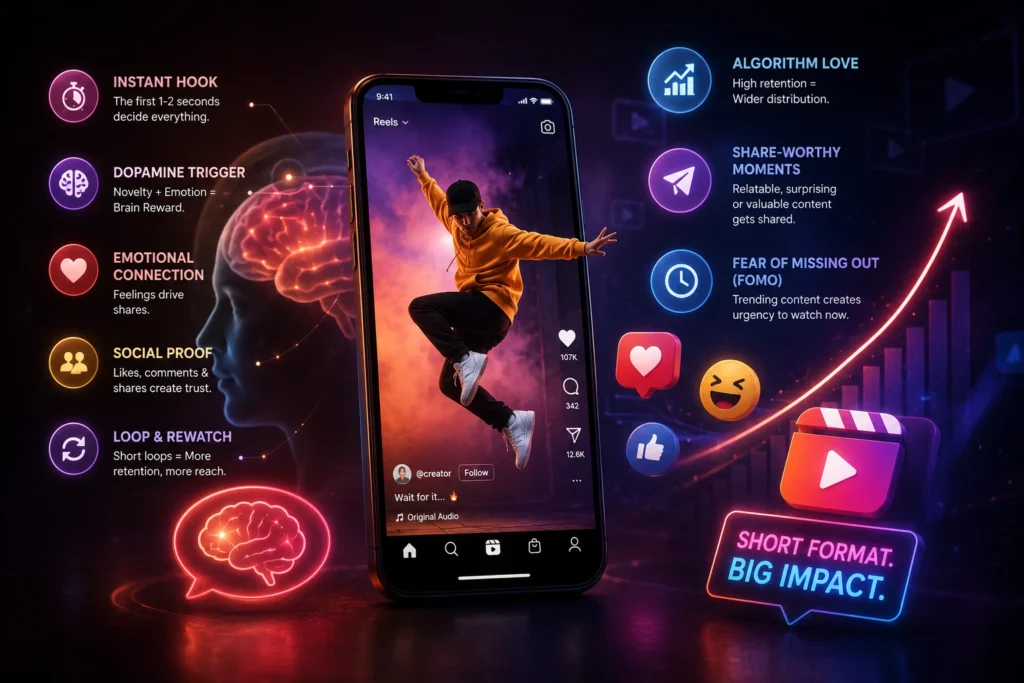
“Virality is less about luck and more about emotional timing.”
Every day, millions of videos are uploaded to Instagram Reels, TikTok, and YouTube Shorts.Most disappear instantly.But a few explode overnight.A random café owner gets 10 million views for making coffee. A student recording a late-night study routine suddenly becomes a creator. A small business packing orders from a tiny room starts reaching audiences across countries.People often call this “luck.”But viral content is rarely random.Behind almost every high-performing Reel or Short lies a deep understanding of human psychology — even if the creator does not realize it consciously.Virality is not only about algorithms.It is about emotion.
The First Three Seconds Decide Everything
Social media today is built on speed.People scroll aggressively. Attention spans are shorter than ever. Audiences decide within seconds whether something deserves their time. That is why the strongest creators focus heavily on hooks.
- Not titles.
- Not hashtags.
- Hooks.
A hook creates an instant psychological interruption.For example: “I lost ₹50,000 because of one mistake…” ,“Nobody talks about this part of freelancing.” ,“This café was empty for 8 months until we changed one thing.”These openings create what psychologists call a curiosity gap — the space between what people know and what they want to know.The brain naturally wants closure.When curiosity is triggered, viewers stay longer.And retention is the most powerful signal for virality.
Humans Are Addicted to Tension and Resolution
The best short-form videos feel like mini movies.Even in 20 seconds, they create:
- Tension
- Curiosity
- Emotional payoff
Think about a simple everyday creator filming:“I tried selling handmade candles for 30 days.”Immediately, the audience wants answers:
- Did it work?
- Did they fail?
- How much did they earn?
- What happened at the end?
That tension keeps people watching.Then comes the reward.Maybe the creator made their first sale. Maybe they failed hilariously. Maybe they learned something emotional.The human brain loves emotional closure.This is why transformation content performs so well online:
- Before vs after
- Glow-ups
- Fitness journeys
- Business progress
- Room makeovers
- Storytime videos
People emotionally invest in change.
Fast Cuts Keep the Brain Stimulated
Modern short-form content is designed to constantly refresh attention.Every cut, zoom, subtitle, sound effect, or transition acts like a small stimulus to the brain.Fast cuts prevent boredom.But more importantly, they create momentum.Imagine watching a cooking Reel:
- Quick ingredient shots
- Fast chopping sounds
- Close-up pouring clips
- Sudden transitions
- Final reveal
The brain receives continuous visual rewards.That keeps dopamine active.This is why older slow-paced content often struggles on platforms built for rapid stimulation.Today’s audience is not just consuming information.They are consuming pace.
Emotional Triggers Matter More Than Production Quality
One of the biggest myths in content creation is that expensive cameras create viral videos.
- They do not.
- Emotion does.
In fact, some of the most viral Reels are filmed casually on phones because they feel more real. Audiences react strongly to emotions like:
- Surprise
- Relatability
- Nostalgia
- Humor
- Inspiration
- Anxiety
- Satisfaction
A perfectly edited video with no emotional depth often performs worse than a raw video with honesty.That is because people remember feelings more than visuals.A college student talking honestly about burnout may outperform a luxury cinematic vlog because audiences emotionally recognize themselves in the story.
- Relatability creates connection.
- Connection creates shares.
- And shares create virality.
Reward Loops Make People Rewatch Content
Many viral creators intentionally design videos that encourage replaying.
This is called a reward loop.
For example:
- Hidden details in videos
- Fast storytelling
- Sudden endings
- “Watch till the end”
- Unexpected plot twists
- Satisfying visuals
When people rewatch, platforms interpret the content as highly engaging.That increases distribution.Even simple creators use this unknowingly.A baker cutting into a perfectly soft cake.A painter revealing final artwork.A creator surprising their parents.These moments create emotional satisfaction that people want to experience again.
Everyday Creators Understand Human Emotion Better Than Big Brands
Interestingly, many small creators out perform companies because they naturally communicate like humans. Brands often overthink content. Creators simply tell stories. A local shop owner saying:“This is the first order we got today.” feels more emotional than a polished advertisement. Why? Because audiences connect with human struggle, progress, hope, and authenticity.The internet today rewards emotional honesty more than corporate perfection.
Virality Is About Making People Feel Something
At its core, viral content is emotional engineering. People share content when it gives them:
- A laugh
- A surprise
- A sense of belonging
- Motivation
- Validation
- Curiosity
- Emotional release
The algorithm only amplifies what humans already respond to emotionally.That is why virality is less about hacking platforms and more about understanding people.Because behind every view, like, save, or share is a simple human reaction:“This made me feel something.”