
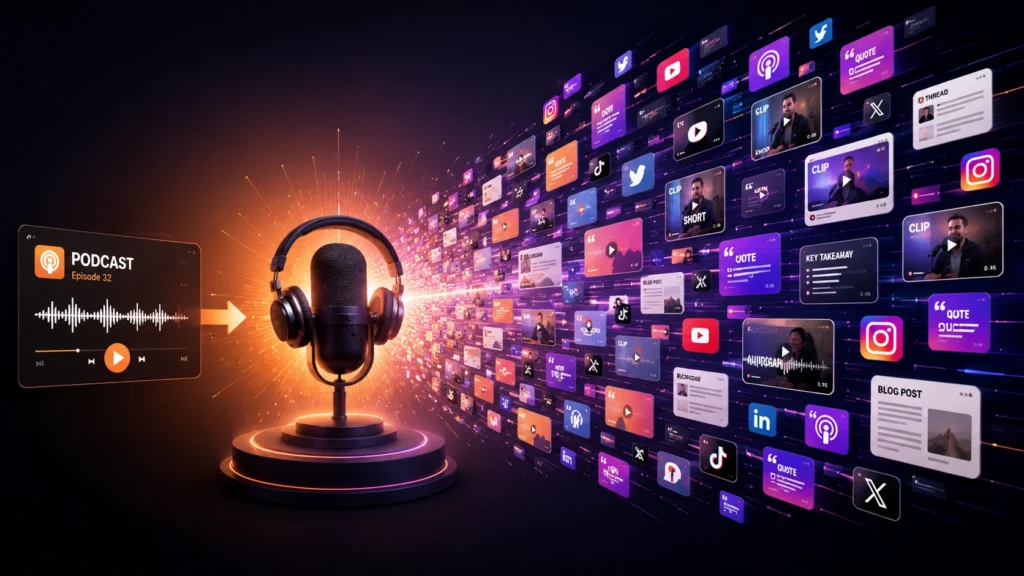
“Long-form content is now mined like a content factory.”
A few years ago, content creation looked very different.Brands spent days creating one polished campaign. Creators uploaded one YouTube video and moved on to the next idea. Podcasts were treated as standalone content pieces — something audiences watched or listened to once before disappearing into the algorithm.Today, one podcast episode can become an entire month of content.A single two-hour conversation can generate:
- Instagram Reels
- TikTok clips
- YouTube Shorts
- LinkedIn posts
- Twitter/X threads
- Quote graphics
- Carousels
- Memes
- Blog articles
- Newsletters
- AI summaries
- Reaction videos
and sometimes hundreds of additional pieces across platforms.This is the rise of the Clipping Economy — where long-form content is no longer consumed once. It is continuously extracted, repackaged, redistributed, and reintroduced to audiences in different formats.The internet no longer rewards creators for making more content.It rewards them for extracting more value from existing content.
Podcasts Became Modern Content Mines
Podcasts are now one of the most powerful raw materials on the internet. Why?
Because long-form conversations naturally contain:
- Stories
- Emotions
- Opinions
- Debates
- Lessons
- Controversial moments
- Motivational lines
- Unexpected reactions
Every few minutes, there is potential for a viral clip.That changed the role of podcasts entirely.Earlier, podcasts were considered “slow media.”Now, they are content ecosystems.A single guest statement can spread across social media for weeks without audiences ever watching the full episode.Sometimes the clip becomes bigger than the podcast itself.
Short-Form Platforms Changed Consumption Habits
The explosion of TikTok, Instagram Reels, and YouTube Shorts transformed how people consume information.
Modern audiences prefer:
- Faster content
- Immediate emotional payoff
- Highlight moments
- Bite-sized insights
- Quick entertainment
This made clipping incredibly powerful.Most people no longer discover creators through full-length podcasts first.They discover them through clips.A 30-second emotional moment from a podcast can introduce millions of people to a creator overnight.In many cases, short-form content became the marketing engine for long-form content.
- The clip feeds the episode.
- The episode feeds more clips.
- And the cycle keeps growing.
The Internet Rewards Repeat Distribution
One reason clipping works so well is because modern algorithms reward repetition.People rarely convert after seeing content once.But when they repeatedly encounter:
- The same creator
- The same podcast
- The same ideas
- The same face
- The same perspective
trust slowly builds.This is why successful creators distribute the same core message across multiple formats.One insight from a podcast may become:
- A motivational Reel
- A business carousel
- A tweet
- A founder story
- A newsletter topic
- A meme template
The message stays similar.Only the packaging changes.The internet today is less about creating singular moments and more about creating continuous visibility.
Clipping Is Changing Media Itself
Traditional media depended heavily on full consumption.
- Television wanted viewers to watch entire shows.
- Blogs wanted users to read full articles.
- YouTube creators wanted long watch sessions.
But clipping changed audience behavior completely.Today, many people experience media through fragments.They consume:
- Highlights instead of full interviews
- Quotes instead of books
- Clips instead of podcasts
- Summaries instead of articles
Attention became modular.This creates both opportunities and problems.On one hand, clipping increases reach dramatically.On the other hand, ideas can lose context when reduced into short viral moments.A nuanced two-hour conversation can suddenly become a 20-second controversial clip online.That is one reason modern internet culture often feels faster, louder, and more reactive.
AI Is Accelerating the Clipping Economy
Artificial intelligence is making this movement even bigger.Today, AI tools can automatically:
- Detect viral moments
- Add captions
- Create Shorts
- Generate hooks
- Write summaries
- Repurpose podcasts into articles
- Turn videos into threads
- Create subtitles instantly
What once required an entire editing team can now happen in minutes.This means creators can scale content distribution faster than ever before.
- A single podcast is no longer just content.
- It becomes raw data for multiple platforms.
- The modern creator is not simply recording conversations anymore.
- They are building content pipelines.
Why Podcast Studios Suddenly Became Businesses
The clipping economy also created a new industry entirely:
podcast production ecosystems.
Today, many podcast studios do not only record episodes.
They offer:
- Clip editing
- Short-form strategy
- Thumbnail design
- Distribution systems
- Social media management
- Viral optimization
- AI repurposing workflows
Because creators now understand something important:
- Distribution is often more powerful than creation itself.
- A brilliant podcast nobody sees has little impact.
- But one strong clip can change a creator’s career overnight.
The Psychology Behind Clipping Culture
Clips work because they are emotionally engineered for attention.
The best clips usually contain:
- Strong opinions
- Emotional storytelling
- Curiosity gaps
- Relatable struggles
- Conflict
- Transformation
- Humor
- Motivation
A clip creates instant emotional engagement before audiences even fully understand the creator.
That emotional reaction drives:
- Shares
- Comments
- Saves
- Reposts
And algorithms amplify emotional engagement aggressively.
In many ways, clipping culture transformed creators into constant attention machines.
The Future of Content Is Extraction, Not Creation
The biggest shift happening right now is philosophical.Creators no longer ask:“What should we create today?”
They ask: “What else can we extract from what we already created?”That mindset is redefining modern marketing, media, and personal branding.Because in today’s internet economy, one piece of long-form content is no longer one piece of content.It is an entire content universe waiting to be distributed.And the creators who understand distribution psychology will dominate attention for years to come.